Creative restraint is one of the best things about indie development. Keeping hooks to a minimum allows smaller studios to execute on an idea well, providing us with a fun and cohesive experience. Some hooks, though, just aren't compelling enough to fill up an entire game, no matter the amount of iteration.

I feel like this is Berzerk Ball [$.99] in a nutshell. It has a fantastic suite of rewards systems, but it's ultimately a shallow game that offers a lackluster campaign and no meaningful new ideas that bring something to the "press a button to launch something" genre which already has been done to death on the App Store.

But I'm not here to harp on how much Berzerk Ball leaves to be desire conceptually. Instead, I want to turn your attention to its reward systems because I think they're a brilliant spot of design that gives the game longer legs than it should have and kept me playing for hours.
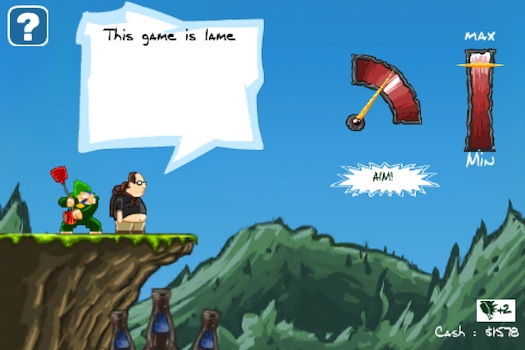
Backing up,�Berzerk Ball is a game about hitting things. The goal is to launch a flesh-and-blood "geek" as far as you can by hitting him with a violent object. It isn't rocket science; you pick an avatar, line up an accuracy and a power meter, and then tap the screen to whack the geek.

The geek then sails through a randomly generated level, perhaps colliding into various bits of the environment that can either stop him cold or propel him even more. Later, you'll get the ability to hit him multiple times after the initial launch, adding even more distance.
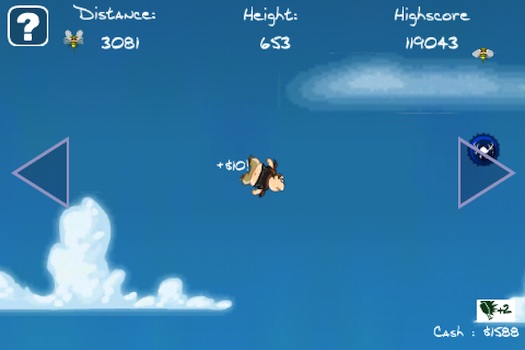
The coolest rewards system is one that actually informs you go about playing: the�RPG leveling mechanic. Each avatar has three core stats that can be bumped up by experience points that you earn from launching the nerd. Slowly, as you play, you'll end up not caring a high score like the game hopes you will. You'll care about the EXP instead.�In part, this is because the effects of a level-up are quick, palpable, and also came at zero risk; you feel the new power and then can immediately harness it to earn even more EXP. Plus, nothing could ever go wrong. These points are yours forever.

Think about this in the context of a popular MMO like World of Warcraft. Fans get wrapped up in the social elements and raiding, sure, but for the majority of the humans playing the game, it's about the race to the top, the points. And, really, there's no meaningful repercussions to failure in WOW, either. You lose a few armor points or whatever � no big deal when compared to possibly losing entire levels.
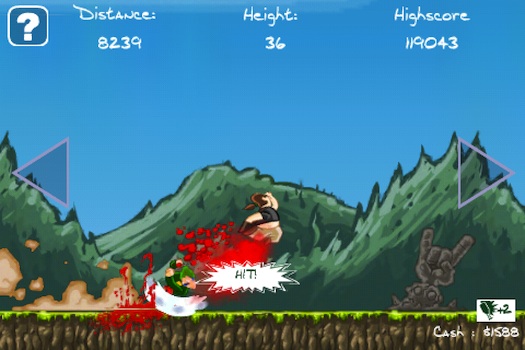
What I'm saying here is that leveling is a powerful motivator and Berzerk Studio absolutely NAILS this mechanic in its iOS release, adding much more to the overall experience. It's really surprising to me when I think about how much time I've spent in this game despite the fact that I recognize it doesn't have that much to offer. Hats off to these folks for the work.

I'd also like to make a quick mention of the achievements system, which also kind of scooped me up and had me doing stupid stuff in order to earn them. There's been a lot of writing over the years about the effectiveness of achievements, so I'll spare you the high-brow crap, but I will say this: what's employed here will probably keep you hooked.

And look, I'm not the kind of guy that reflects on a game like Berzerk Ball. It's not a particularly thoughtful project. After all, it's premised on bloodying a nerd by drilling him him with shotguns, axes, and the sort. But it managed to grab me in a way that many of its brethren � flash game or not � haven't, so that's pretty cool and noteworthy.

<!-- PHP 5.x -->


Webmaster Forum | SEO Forum | Coding Forum | Graphics Forum

Last month, retro revival studio DotEmu, who brought us ports of�Nicky Boom, Krypton Egg, and R-Type among others, signed a deal with the noted Japanese development and publishing house Jaleco LTD to bring 17 arcade conversions to the App Store, all of which will self-published by DotEmu. The first title out of the gate was Avenging Spirit (1991), which launched in December.

During a walk with his girlfriend, a boy is ambushed by agents of a mysterious crime organization and is shot to death. Now, as a wandering spirit with the ability to possess most others, he is summoned by his girlfriend's father to save her from these criminals

The game is a run-and-jump platformer that sets itself apart due to its "possess anyone" mechanic. You start out as a Casper-cute ghost and make your initial possession. Then, when you die, your ghost pops out and you can take control of most any character onscreen. Your fighting abilities depend upon who you've possessed, so it mixes the game up nicely.

Avenging Spirit is controlled by way of an onscreen stick and button arrangement that works about as well as you'd expect for a game of the sort. A standard Arcade playmode is present, as is a Freeplay mode where you can't die or unlock new levels, that's good for practice. By default, the game is played fullscreen, but a windowed mode is available that renders the game at it's original arcade resolution. Game Center integration takes your score online and tracks achievements.

DotEmu's Avenging Spirit trailer shows a sample of the gameplay.

DotEmu CEO Xavier Liard has just given us a heads-up on the second title from the Jaleco arcade series, which should be making its App Store debut shortly. Earth Defense Force (or E.D.F.) is a side-scrolling space shooter that saw an arcade release in 1991, an SNES release soon after (as Super Earth Defense Force), and has much more recently landed on the Wii Virtual Console.

The alien Azyma Empire, threatens to destroy the Earth with the Orbital Buster, a large computerized space satellite. The Earth's only hope lies in the recently developed XA-1 spaceships held under the organization known as E.D.F: Earth Defense Force. You are the pilot in command!

The game will feature both Arcade and Freeplay modes, both touch and D-pad controls modes, Game Center integration for online leaderboards and achievement tracking, and the ability to switch to tunes from your iTunes library.

Liard indicates that, based on feedback received from the studio's iOS conversion of R-Type, they decided to add a small touch area to the left of the game's playfield, to avoid the "finger hides the ship" dilemma. He feels the small loss of game area is well worth the overall effect of this control approach.

We'll bring news of the DotEmu's third release when we get it, but in the mean time…the studio indicates that somewhere hidden on their Jaleo games page is a hint as to what the third conversion will be. Can you find it?

<!-- PHP 5.x -->


Webmaster Forum | SEO Forum | Coding Forum | Graphics Forum

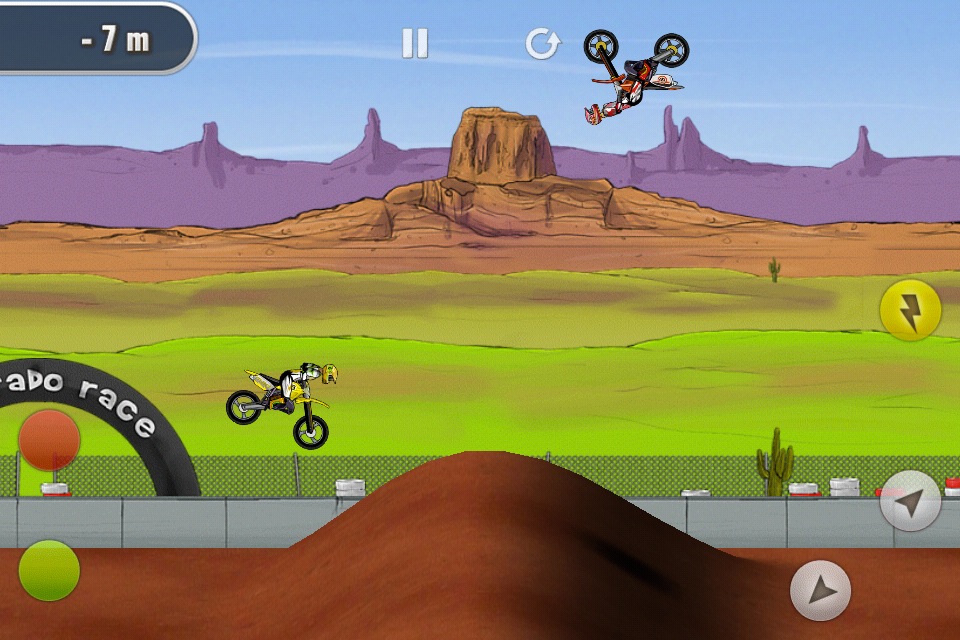
This past Friday we went hands-on with Mad Skills Motocross from Turborilla and Racer X Online, and as of today the game is now available in the App Store. Mad Skills Motocross [$1.99] is a 2D side-scrolling motocross game, somewhat similar to the classic Excitebike but with enhanced visuals and an absolutely brilliant physics system. It lacks a couple of features that we've seen implemented in similar titles over the years, namely real-time online play and a level editor, but makes up for it by being fast, smooth, challenging, and above all else a total blast to play.

The controls in Mad Skills Motocross are simple, with gas and break buttons on the left and buttons to lean forwards or backwards on the right. Additionally you have the option of flipping the position of these controls or using the accelerometer for tilting. You can perform various tricks on your bike as well, like front flips, back flips, wheelies, and stoppies. There are also a number of special moves for your bike that you will gain through playing, like a vertical jump or a nitro boost. Utilizing your entire suite of abilities is essential to performing well in the game.

The meat of Mad Skills Motocross is the Career mode which features a whopping 52 tracks spread across 5 increasingly difficult racing divisions. Levels start out modest enough, and ease you into the basics of jumping, racing, and tricking. But fairly quickly the difficulty ramps up, and it will be a true test of your skills to win out against the AI controlled opponent in order to complete all of the available levels. Thankfully, there are always a few levels unlocked at a time, so if you get stuck on a particularly challenging race you can skip it for the time being and play a later one.

Besides the Career mode, there is also a robust Time Attack mode. Here the top 5 best times are saved from each individual track, along with full replays for each one. You can choose to "attack" any of these times and compete against your own ghost in an effort to improve that time. You can also send a challenge through OpenFeint for any of these times to see if one of your buddies is able to defeat your ghost racer. OpenFeint also includes achievements as well as leaderboards for every track, which is perfectly suited for this type of game.

All of these features come together really well in Mad Skills Motocross, and the whole experience is heightened by the wonderful physics system. The most subtle nuances of how you take off or land when jumping can affect your overall performance, and this is the type of game where you will replay a level over and over again just to get that "perfect run" and shave tenths of a second from your time. It just feels so fluid to lean far back on your bike and pick up speed, lurch forward as you launch from a jump and then land smoothly down the other side. There's a real rhythm to racing that is very satisfying to learn and try to master.

The simplest way I can put it is that Mad Skills Motocross is pure fun. While it doesn't have real-time online multiplayer like the similar iOS game Motocross Challenge [99�/Lite], the OpenFeint challenge system is a good substitute and actually might be a better fit for gaming on the go. The desktop version of Mad Skills Motocross features a level editor, and although that didn't make it into the iOS version of the game, the developers are keen on finding a way to squeeze that in sometime in the future if possible. With the 52 tracks in the game, there is no lack in variety of places to race even without an editor, although it would be a cool feature to have.

Impressions from players in our forums are overwhelmingly positive, and if you're in the market for a fast-paced arcade-style racing game it doesn't get much better than Mad Skills Motocross.

<!-- PHP 5.x -->


Webmaster Forum | SEO Forum | Coding Forum | Graphics Forum

When developer CAVE launched their fantastic dual-stick shooter Mushihimesama Bug Panic [$4.99/Lite] back in November, the game came equipped with Game Center for high score and achievement tracking. With popularity of the then relatively new Game Center rising, CAVE fans were quick to wonder if their previous iOS offerings Espgaluda II [$8.99/Lite] and Dodonpachi Resurrection [$8.99/Lite] would see some love in the form of Apple's social network.

Over the weekend CAVE did just that, and has released updates for both Dodonpachi and Espgaluda II with Game Center. It will work in harmony with the existing OpenFeint integration, and any previously earned achievements or high scores will instantly carry over to Game Center, and either network can be accessed easily from within both games.

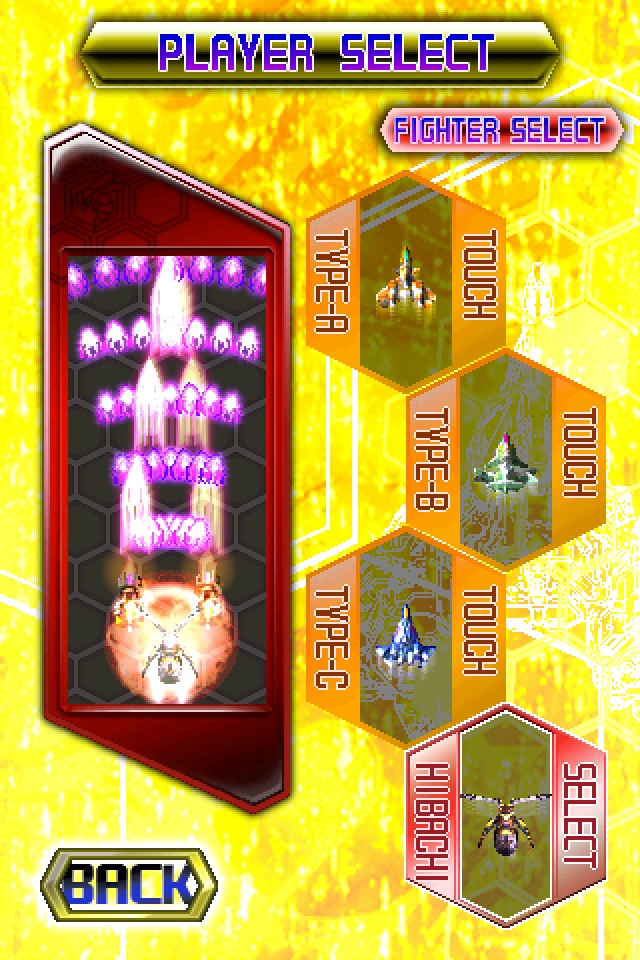
As cool as having Game Center in two of my favorite shmups is, CAVE has an even more exciting surprise for owners of Dodonpachi Resurrection. Hardcore players of the game probably know about the many hidden elements in the game, such as alternate routes and enemies, which CAVE has�previously covered on their blog. Now in this latest update, they have divulged one of the biggest secrets in the game, a hidden boss character named ]-[|/34<#! (Hibachi), which can also be accessed as a playable ship.

Expert players may have already run into Hibachi, as playing through the game taking the alternate 2nd loop route results in facing Hibachi as the true final boss of the game, and defeating him unlocks the ship for play in iPhone mode. Since defeating Hibachi is extremely difficult, CAVE didn't want to limit its availability to hardcore players, and so they have included an alternate method of unlocking the ship by using an old-school style button input at the ship selection screen. Both methods are detailed in this lengthy video from their latest blog post (skip to the 7:00 mark to go straight to the input code, but you'll be missing out on the expert play of "Assistant A"):

If there's one thing I love more than a great game, it's a great game with awesome hidden stuff in it. Dodonpachi Resurrection is one of my most played games, but I am nowhere near the skill level required to unlock Hibachi using the intended method, so I really appreciate having an easier way to do so. It should be noted that unlocking Hibachi by defeating him in the game makes him available forever, but using the input code only unlocks the ship for that session, and the code will need to be put in again each time you start a new game.

If you have yet to pick up either of CAVE's shooters, you can read our review of Dodonpachi Resurrection here and the review for Espgaluda II here, and both games have lite versions to try. If you already own either, grab these latest updates for some Game Center action and be sure to check out the hidden playable ship Hibachi in Dodonpachi Resurrection.

App Store Links:

<!-- PHP 5.x -->


Webmaster Forum | SEO Forum | Coding Forum | Graphics Forum