Tuesday, July 12, 2011 2:51 PM

 Reviewing card games is always tricky for me. As I've mentioned in previous card game reviews, I've been playing Magic: The Gathering on a competitive level since the earliest days of the game which gives me an entirely different perspective on card games from most gamers. People on our forums are having a fantastic time with Ascension: Chronicle of the Godslayer [$4.99 / Lite], and from a technical perspective it's absolutely fantastic, but all this really does is make me wish that we could finally get iOS ports of some of the better card games out there.
From a technical standpoint, there's really not much more you could ask for. First off, the game is universal and plays great on both the iPad as well as smaller iOS devices. I find myself preferring it on the iPad since the increased screen real estate really lends itself to games like this, but it's just as good on the iPhone. The touch interface works great with card games, as anyone who has basically played any card game on an iOS device could tell you, and Ascension is no different. There's options to make the game run as fast (or as slow) as you'd like, multiple levels of AI, and even online multiplayer via Game Center.
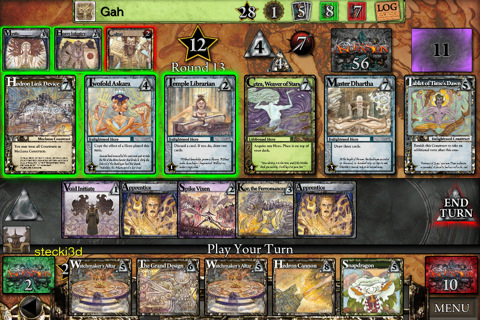
The actual game of Ascension is a somewhat refreshing spin on fantasy-based card games in that instead of building a specific deck that you use in battles, you're building your deck on the fly from game to game. Players start the game with identical basic decks of ten cards consisting of two militia cards which provide the "power" resource and eight apprentice cards which provide the "rune" resource. Using power and runes you're able to interact with a common pool of cards to either acquire new cards for your deck or defeat monster cards. Most actions you do in the game award different amounts of victory points, and at the end of the game, the player with the most victory points wins.
Like most card games, Ascension: Chronicle of the Godslayer is infinitely easier to explain visually. The good news is, Ascension started its life as a physical card game, so there's no shortage of incredibly detailed videos on how the game works. Here's a particularly fantastic one from Tom Vasel of The Dice Tower:
There's some things that I really like about Ascension. Similar to Dominion, it's really cool how each game starts off totally fresh. Unlike games where players have decks they've built themselves, no one can enter a game with a stacked deck filled with the best cards. Everyone has access to the same card pool, and there's a decent amount of variety in the deck building strategy you can try to follow from game to game. If you have an opponent that did something interesting with how they built their deck, you can try doing something similar the next game. As someone who has invested thousands of dollars into specific Magic decks that I've been more or less locked into playing through entire set rotations, this is just awesome.
But with the good, there's a hefty amount of bad. First off, the card art is laughably terrible. It seems like placeholder art that just never got refined, and some of the card art flat out looks unfinished. I'm not sure if this is intentional or not, but there is an incredibly odd contrast between how great Ascension is as an iOS game from a technical perspective and how poor the art is. It's easy enough to overlook, but the art totally jumps out in your first moments with the game which leads to some incredibly mediocre initial impressions.
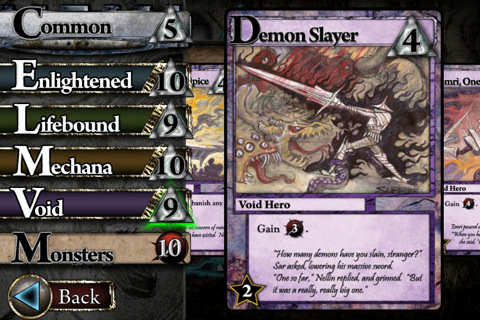 While I really like the nature of these types of deck building games, Ascension is entirely too random, especially with more than two players in the mix. It's virtually impossible to follow any kind of deck building strategy, as you're faced with two layers of randomness: The cards you draw, and the cards that are drawn off the communal deck to replace other cards that have been acquired/defeated by other players. Instead of being able to follow a game-wide strategy, you're faced with focusing on tactics on a turn by turn basis resulting in often disjointed decks and just buying/defeating whatever cards you can that turn.
Lady luck can be a cruel mistress, and sometimes the seemingly awesome deck you've built can be rendered entirely useless based on a series of horrible card draws to the common pool. For instance, one viable deck building strategy involves focusing on cards that generate power to spend slay monsters which can generate a considerable amount of victory points. However, if you hit a unlucky streak of cards in the common card pool with other players being slow to acquire them to get fresh cards on the field, your whole deck stalls out without any substantial monster cards to kill. Also, the high levels of randomness can often let one player in a game get an incredible lead in victory points, making even attempting to finish the game bordering on fairly pointless.
Asynchronous online multiplayer seems incredibly promising, but Ascension is faced with the same problem that so many similar games fall victim to: It can be difficult finding people to play with. I've managed to get a few games going, but a (seemingly) small player base combined with the length of the individual games doesn't lend itself at all to available random matches with people that will play games to completion. When the stars align and you do get into a four player online game, it's a ton of fun, but as soon as a single player becomes unresponsive the entire game grinds to a halt.
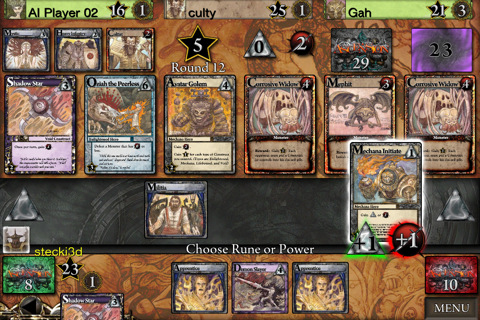
At the end of the day, the developers did an absolutely fantastic job porting Ascension: Chronicle of the Godslayer to iOS devices. I'm not sure what if anything they could have been done differently to make the game better, as all of my issues with Ascension are directly linked to the source material and are shared with the physical version of the game as well. I almost think it's biggest downfall is how precise of a port the game is.
Regardless, if you're interested in fantasty-based card games I'd highly recommend at least giving the lite version of Ascension (which is also universal) a try. As mentioned at the start of this review, I'm fully aware that my outlook towards card games in general might be a little more hardcore than most out there, so you might find my complaints to be not much of an issue for you. Either way, the lite version will give you a great idea whether or not the game of Ascension: Chronicle of the Godslayer jives with you, if it does, definitely grab the full version.
<!-- PHP 5.x --> There's a lot of enthusiasm around Kairosoft right now and rightly so. The studio has