It's not out of the ordinary to see games appear on the App Store with lackluster screenshots, and Vermes On Mars [$0.99] by Aztlan Games couldn't be a better example of that. You couldn't tell what was going on, and all of the screenshots looked a little too similar to each other. Regardless, we decided to give it a spin just to see what the game had to offer, and boy are we glad we did. In fact, I've had such a good time with this top-down 2D Sci-Fi shooter that I'd much rather be playing the next level than writing this review.

In Vermes on Mars, you control four unmanned vehicles on Mars. These vehicles are used to patrol the area and search for minerals, while always watching out for alien lifeforms� Specifically, worms. These big worms (also known as "Vermes") seem to be clearly inspired by the popular science fiction novel and movie, Dune, which I'm a-OK with.

The whole patrolling process works very nicely with the iOS touch controls. If you tap the screen, the four vehicles all move to that area, but if you draw a line, the vehicles automatically distribute themselves along it. While the vehicles are moving, you can draw the next line to modify their as well.� The AI navigation of your lines isn't perfect though, and occasionally the vehicles get stuck against some terrain and need extra help around the corner, but not too often.

When one of your vehicles enters the vicinity of a martian worm, it bursts from under the sand and attacks. This is a good time to switch to weapons mode and blast it before it eats your vehicle. There's eight varieties of worm to encounter but the most deadly are bossworms, which spawn other worms and spit fire. To stand a better chance against the legless alien creatures, you can upgrade each of your four vehicles individually. As you progress through the game, three additional vehicles are unlockable, to strengthen your fleet, if you've earned enough credits. Other items also come into play, like additional weapons, lightning to scare worms from the soil, plus items to provide more time or slow down the aggressive worms.

Once you've cleared an area of worms, the level is completed and the levels adjoining your current location are unlocked. There's a solid 40 levels in total. If you don't locate and neutralize the worms within the allocated time, a sand-storm will destroy your robotic vehicles. Your progress is not lost when you die, so you can retry the level until�successful, although a destroyed vehicle does lose it's upgrades. The music and sound effects are pretty good too, and it even integrates with Game Center for a measly 7 achievements and score rankings.

I've had a ton of fun with Vermes on Mars, but it isn't without its flaws. It's a little awkward to switch between the navigation and combat modes, which is accomplished by double tapping the border of the screen. Also, the sandstorm animation could be better. It doesn't really give you a good indication of where its edges are, which often leads to vehicles being destroyed without looking like they're actually touching it. It would also be nice to be able to position vehicles individually in order to protect weakened vehicles with stronger ones.

Vermes on Mars constantly switches from "calmly patrolling the area" to being attacked, which provides a great feeling of tension and release, as you're constantly anticipating the worms�� Things become even more exciting when multiple worms or larger worms attack simultaneously which makes for a surprisingly fun gameplay experience.� The game is under 20MB so you can download it via 3G, and it's even universal, making it easy to grab and play on whatever device you'd like.

<!-- PHP 5.x -->


Powered By WizardRSS.com | Full Text RSS Feed | Amazon Plugin | Settlement Statement | WordPress Tutorials

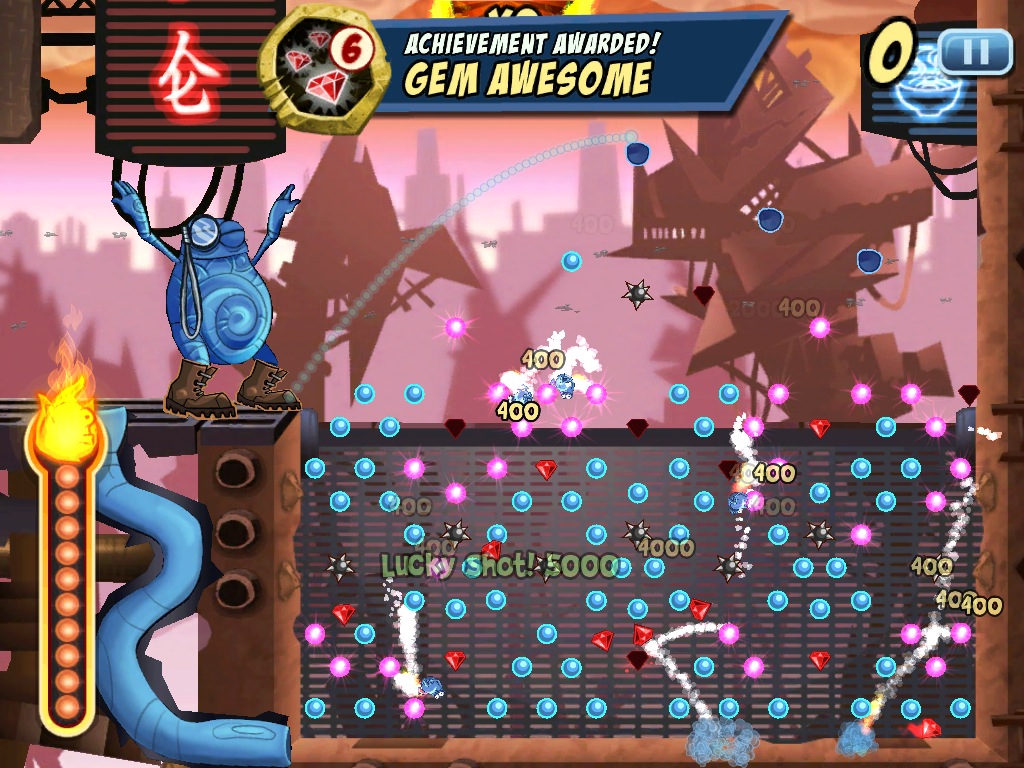
Last week, we took a look at the trailer for Hothead Games' Kickin Momma [99�/UHD], and left with the impression that it was pretty much Peggle [$2.99] with an added baby kicking element. After playing with the final product, I don't think I could come up with a more apt description. Kickin Momma centers around a similar type of Pachinko-like ball-bouncing gameplay that PopCap's title employs, and it does a great job at capturing the same kind of fun factor. It does add a few minor twists to the formula though, and finishes things off with its own brand of wackiness and top-notch production values.

The story follows a blue pear-shaped character named Momma, who has her sights set on an expensive jewel necklace. The problem is, she just can't afford it. Not content to live without this prized possession, she solemnly lumbers over to the edge of a cliff, possibly to leap off and end her suffering from desire. Then, after kicking a rock over the edge, she discovers the canyon is littered with bright pegs and fantastic jewels just like the ones from her coveted necklace. Suddenly it hits her � she can take her babies and kick them one by one into the canyon to collect the jewels for her. Sounds like a logical solution to me!

The absurdity of the premise for Kickin Momma is actually a large part of its appeal. It may sound horribly immoral, but before you run off calling Child Protective Services, keep in mind that Momma is a big ol' alien (er, uh, something),�and the children seem to rather enjoy their bouncy journey to the bottom of the canyon, and always come out unscathed. So, you know, everybody wins in this scenario. So relax, tee up a baby, and punt your way towards riches.

There are 36 levels in Kickin Momma spread out over 3 different worlds, with a spot for a 4th world hinted at for a future update. You begin a level from the left of the play field, where you will set the trajectory of your kick using a handy arrow guide. Touching and dragging will stretch and point the guide wherever you want it to go, and a set of arrows surrounding a "kick" button give you the ability to have more incremental movements if you need to be more precise.

You start out with just a few children to kick, represented by the number in the upper left corner, but you can earn more as you play by scoring well on each turn. There are 10 red jewels in each level, and the main goal is always to knock them down from the play area to the ground where they are collected, with a minimum number needing to be collected to pass each level. Beyond that, you can also score big by triggering bonuses for lengthy bounces, hitting special blocks, or nailing enough pegs in a single turn to fill up an "on fire" type of meter. Your total score for each level will determine whether you earn a bronze, silver, or gold medal.

Kickin Momma's gameplay is largely based around luck. You'll aim your shot, kick a baby, and watch as it pinballs around the playing field, hopefully racking up enough points and jewels to advance to the next level. But, that doesn't mean it's completely devoid of strategy. You're given a tiny window in the upper corner that gives you a close up view of your guide arrow's tip. Success often lies in placing the guide at just the right position to bounce off a peg, nab a jewel you need, or earn some bonuses for a big score. It can take some good decision making and skill to collect enough jewels to pass a level, let alone earn a score good enough to net a gold medal.

As you progress, additional elements are added into the gameplay like different types of pegs, bombs, characters, and other items that keep things fresh. One of the highlights of Kickin Momma is the crazy art style and over-the-top effects that are constantly blasting all over the screen. Momma is known to bust crazy dance maneuvers while her babies are bouncing around, and typically her antics are pretty hilarious. You can also unlock several items to customize Momma with, like a mustache, boots, and a monocle. That's right, Momma got a 'stache. I told you this game is weird.

Depending on the your score in each turn, you are also treated to various fireworks, particle effects, and so much confetti you might think Rip Taylor was on the game design team. In general, this is what I like most about Kickin Momma. The gameplay isn't the deepest, but it's always fun, and who doesn't love watching a ton of shiny effects bursting right before their eyes while a giant blue alien thing does the worm off to the side?

Kickin Momma comes with enough levels to keep you busy for some time, especially if you go back to earn a gold medal on each one. Plus, there's Game Center achievements and leaderboards that increase the replay value even further. It comes in 2 flavors � a standard definition version designed for older devices, and a universal HD version for the iPad or Retina Display devices. If you enjoyed the somewhat crazy, random, arcade-style of Peggle's gameplay, then you will likely enjoy Kickin Momma as well, just as players in our forums currently are.

<!-- PHP 5.x -->


Powered By WizardRSS.com | Full Text RSS Feed | Amazon Plugin | Settlement Statement | WordPress Tutorials

It's hard to believe that Zepto Lab's classic, Cut the Rope [$0.99/Lite/HD/HD Lite], is less than a year old. In that time it's inspired a legion of physics-puzzle copycats. It's also hard to believe that we only learned about Cut the Rope: Experiments [$0.99/HD] two days ago, and now it's available on the App Store. But hey, it's a pretty amazing world.

If you've somehow managed to go this long without trying Cut the Rope, here's what you need to know: it's a physics puzzle game, it's awesome, and you should buy it. It stars an adorable monster named Om Nom, who's trapped in a series of boxes and needs to be fed candy. You spend your time working your way through the insane contraptions designed to hold the candy back. Our original review has all the details, give or take a few major updates.

Those details are relevant here, because Cut the Rope: Experiments is very much an expansion of the original game. It introduces no new elements beyond a couple new gadgets. The art is the same, the interface is virtually identical, and the controls haven't changed. Om Nom didn't need any work, and he's still lovable as ever. If it weren't for the difficulty curve, I wouldn't have been surprised to see these levels pop up as new boxes in the original game.

The difficulty curve is decidedly strange this time around. There are 75 levels split up into three sections. The first 25 levels reintroduce players to nearly all the mechanics of the original game. For experienced players, this will be a breeze. But having everything thrown at you over the course of just 25 levels might be alienating to new players.

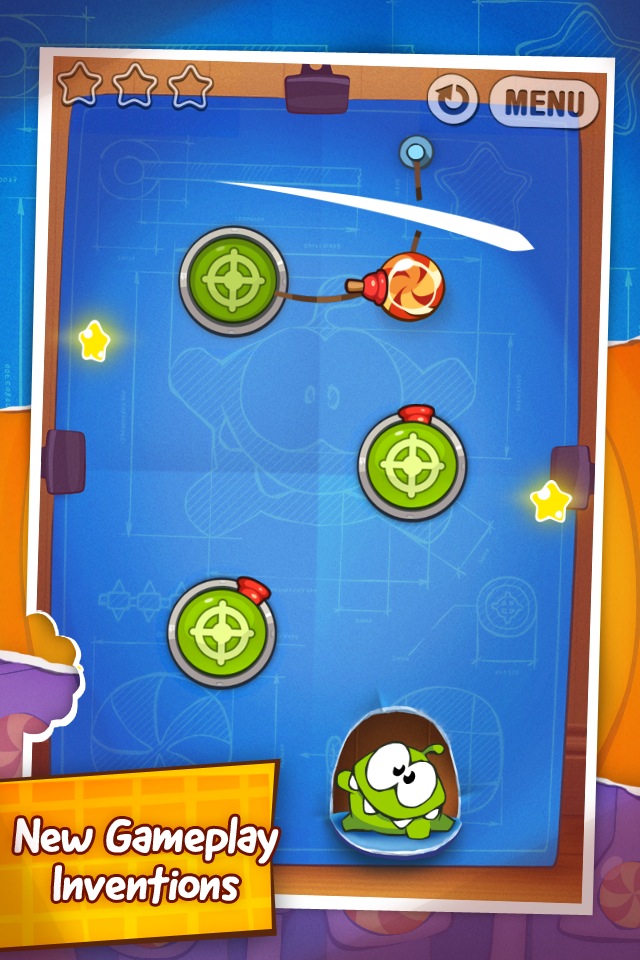
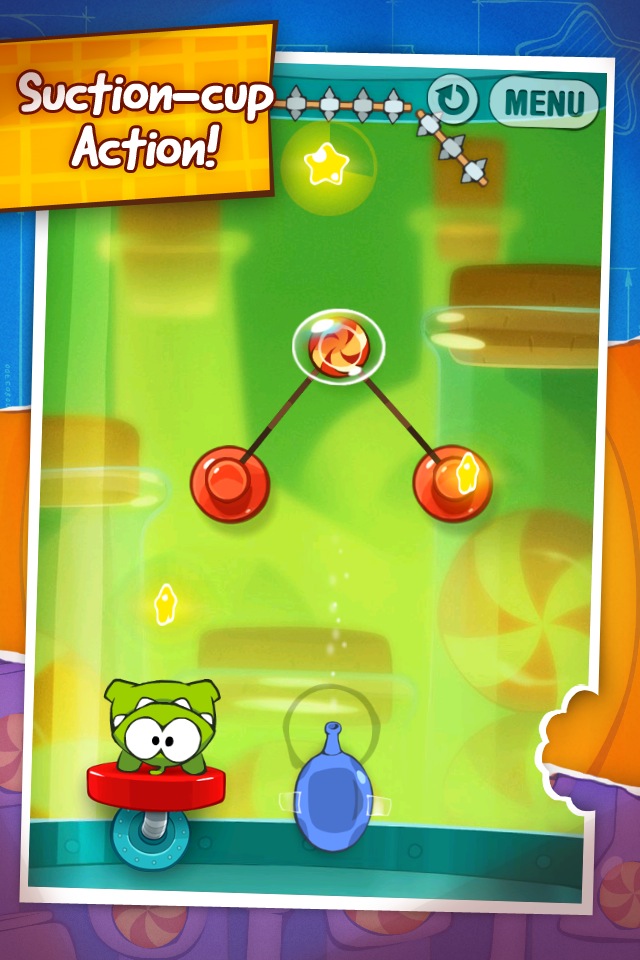
In the other two sections you're given two new gadgets to play with, and they're both quite cool. One is a button that shoots a rope at the candy. The rope can snag it in midair, leading to some impressive carnival stunts. The other is a rope on a suction cup that can be attached and detached with a touch. It still obeys the laws of physics, so you need to be quick to reattach it while it's dropping. Both of the new gadgets give you a bit more freedom to move the candy around the levels, and they're great fun to play with.

But the fun is over much too soon. The new levels won't pose a serious challenge to players who have already mastered all 8 boxes in the previous games, and there are fewer of them than were included in the original when it launched. Our forum users largely agree that it feels a bit too easy, and a bit too small. I don't want to complain � after all, Zepto Lab has been incredibly generous with post-release support in the past, and I'm sure Experiments will be no different. I'm just a bit bummed out that there isn't something newer, shinier or bigger to tell you about here.

If you loved Cut the Rope and still want more, you should definitely get Experiments. Along with 75 new levels, you'll get Game Center achievements and leaderboards (no Crystal support this time around, since Chillingo wasn't the publisher), unlockable pictures, and a game with lots of room to grow. It's nice to see Om Nom finally freed from the boxes, and the professor has the potential to add a bit more storyline to the series. But if you're looking for something that changes up the formula, significantly expands on the original or otherwise feels brand new, you won't find it here.

<!-- PHP 5.x -->


Powered By WizardRSS.com | Full Text RSS Feed | Amazon Plugin | Settlement Statement | WordPress Tutorials

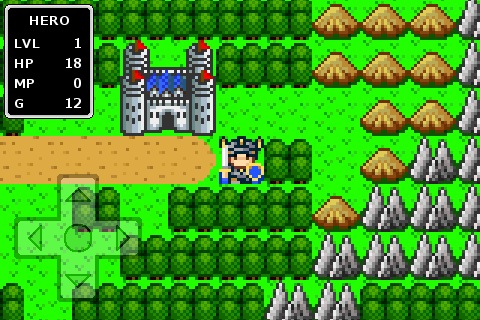
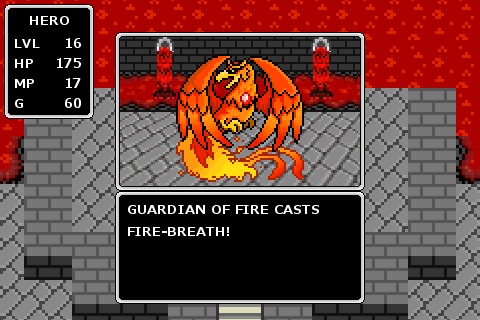
If you grew up in the '80s playing RPGs like Dragon Warrior and Ultima, you're going to immediately recognize the roots of 9th Bit Games' Guardian Saga [$1.99]. Heck, the name is even borrowed from the DOS-era Ultima games. It's about as old school as you can get without releasing a text-adventure, and while it will certainly appeal to fans of the era, it's also going to provide a steep learning curve for newcomers.

As these things tend to go, the story kicks off with you learning about the Guardian Beasts, the giant monsters who protect humanity from evil, but who have decided to stop. Your job is to find out why. To do so, you'll need to adventure around the world searching out the Guardians and unraveling the mystery of what happened.

It's a relatively basic RPG story, and the game is rooted in basic gameplay. You won't find the complex party management of the Final Fantasy series, nor will you find a map, fancy visuals, sub-plots, side quests or a love story � this is all about you exploring the world on your own, doing a little grinding and unearthing the truth. To that end, Guardian Saga does a fantastic job of giving you not only a clear sense of progression, but also the tools get the job done.

Being a lonely hero means you acquire all the skills necessary to survive. You don't have team members, so you'll be healing yourself, casting spells, taking potions and everything else on your own. You'll also need to use your own memory to tackle objectives � no notepad, quest screen, or hint guides here � when the king tell you to go to the town in the Northeast, you have to remember it. You'll spend most of your time in the overworld, but there are a few dungeons spread around and the towers that hold the Guardians to explore, as well as a diverse cast of enemies to kill.

The same premise goes into how you level up and chose your weapons. Leveling is automatic, and weapons are essentially bound to the town you travel to. You won't find yourself making any hard choices between swords or armor, you'll just purchase the best one you can. There is rarely much in the way of loot on your travels, which means you'll be doing most of your stocking in town. It's a bit jarring at first, especially if you're used to grabbing a potion or two off an enemy, but considering you can't use items in combat, it's clear 9th Bit wasn't too concerned with item management.

The nostalgia delves deep into the aesthetics as well. The 8-bit graphics aren't updated with modern colors or pixel density, and the score and sound effects sound entirely composed using the limited hardware of the NES. It still looks fantastic though, and I'd love to see an iPad version of it just to stare at the visuals on a bigger screen without the oversized directional pad of double-sizing it.

That said,�Guardian Saga dwells in its past to a point of absurdity at some points. As a mobile game, it could have stood to have a better save option, and while there is a means to quick save before you exit it would be nice to have multi-tasking support for when you receive a call. The quick save is unforgiving as well. You'll be kicked out of the game after doing so and you can only return to that exact point. That's not a complaint � more of a warning � one quicksave per game session, one use only.

It might also have been nice to have a quest system in place, if nothing else to remind you of what you were doing if you put it down for a while. It's also worth noting that you can check out your character stats by tapping the box in the left corner. It took me an embarrassingly long time to figure out I could heal, use items, and quick save from this menu. This is all to say that there are a few modern conveniences that it would be nice to see here simply because there are added complexities with a mobile game that didn't exist back then. It's clear these were left out on purpose, but that doesn't mean they wouldn't be handy for playing on the go.

Even through the moments of frustration, fans of early RPGs will find a lot to love in�Guardian Saga. It's a solid homage to everything that made the NES and DOS eras influential and interesting. Once you get the hang of it and remember some of the tricks from the '80s, Guardian Saga clicks and settles in well. This isn't a game for fans of in-depth, complex story arcs or ridiculous item management; it's for fans of a simpler time, when RPGs meant you leveled up, killed some monsters and saved the word and nothing more.

<!-- PHP 5.x -->


Powered By WizardRSS.com | Full Text RSS Feed | Amazon Plugin | Settlement Statement | WordPress Tutorials