After being an Android exclusive for half a year, Pachinko Frenzy [Free], the latest from ngmoco, has arrived on iOS hoping to whet the appetite of Pachinko addicts everywhere. While that itch is certainly scratched with this game, Pachinko Frenzy's freemium underpinnings unfortunately detract from the overall gameplay to the point where only the most hardcore of Pachinko fans will continue to play the game for longer than a few sessions.

For those unfamiliar with the early 20th�century Japanese gaming device, we gave a good explanation of it in our review of the 2009 Pachinko [$0.99] iOS game. Essentially, small metal spheres are launched into the Pachinko machine with the goal of hitting as many stationary pins as possible, racking up points and generating more balls. Pachinko Frenzy takes this further by incorporating mini-games that can be earned when every pin on the board is lit up.

Mini-games range from trying to keep a single ball live for as long as possible, to trying to hit as many consecutive pins on one ball, and more. Do well in these mini-games and prizes can be earned, including collective trophies that can unlock new boards when enough of them are collected. Overall,�Pachinko Frenzy does a good job emulating a standard Pachinko board, assuming you aren't put off by the excessive anime motif. Just make sure that you have the latest generation of iOS devices, as�Pachinko Frenzy isn't compatible with anything earlier (and does occasionally slow down on the iPhone 4, no less).

Where the game starts to falter, unfortunately, is in its freemium implementation. The game starts out with only one board unlocked, and you can only unlock additional boards by "selling" 1000 balls or by collecting all the trophies associated with a locked board. Acquiring 1000 balls appears to be an exercise in futility, as you start out with 50, and it's extremely slow going trying to earn more than that (unless you're some kind of Pachinko Savant). The developers predicted this, and included the option to purchase additional balls as IAP, but as of this writing, IAP hasn't been implemented yet. This leads to trophy collection as the only other alternative to unlocking the additional boards, which is definitely possible but would take an extremely long time. Odds are most players would probably lose interest in the one board before any additional ones could be unlocked.

One of the goals of Pachinko is to feed the addiction of possible reward by playing a game based mostly on random chance. If you're looking for a time-waster that accomplishes that, or you're a fan of Pachinko, you can't go wrong with Pachinko Frenzy. However, don't think you're going to be unlocking new boards any time soon, unless you put in a good deal of time or money (once IAP goes live).

<!-- PHP 5.x -->


Powered By WizardRSS.com | Full Text RSS Feed | Amazon Plugin | Settlement Statement | WordPress Tutorials

Labels:

Whether or not this is innovation is up to you to decide. Steer Safe is based on the idea that using your mobile device while driving can be safer, its basically a dock that is attached to the top of your steering wheel. By doing so, the designers believe driving will be safer as you'll be able to keep your eyes on the road and won't need to look towards either side to stare at your sat nav or find out who's calling you while you're busy driving.


The Steer Safe dock will universally fit almost any device shaped like a mobile phone ie iOS devices, BlackBerries, Android smartphones as well as mp3 players.


As you can see in the video below, it also lets you rotate your device onto landscape mode in case you need it for turn by turn navigation. The good thing is I suppose its not very obstructive and it won't hit your knees when you turn, but many will probably take abit of time to get used to as most of us aren't used to having something stuck in the top-center of our wheel.

If you support the idea and want to make the concept a reality, jump to the Kickstarter page via the link below and give the creators your support…

[via Kickstarter]

Related Posts with Thumbnails


Powered By WizardRSS.com | Full Text RSS Feed | Amazon Plugin | Settlement Statement | WordPress Tutorials

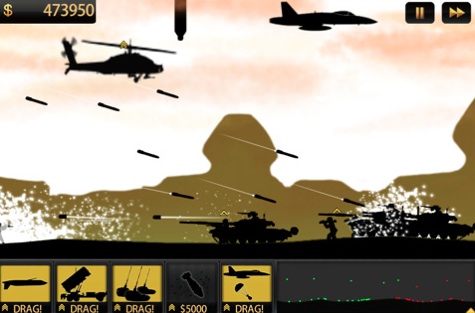
Just so we're clear, VOLV's Dawn of War [$.99] has nothing to do with Relic Entertainment's RTS series of the same name. While I'd imagine this will cause some legal woes down the road, it does present a cool contrast at the moment. This Dawn of War is a 2D side-scrolling strategy game grounded in the technology of modern warfare. Its backdrops and armies are also based firmly in our actual world. Relic's Dawn of War, on the other hand, is filled with thickly plated space imperialists and mutants tainted by a ruthless intergalactic nether realm.

Most strategy games we see are firmly entrenched in sci-fi or fantasy like Relic's game, so its neat play one that doesn't try to stretch the limits of the imagination. But, a slice of realism does not a good game make: Dawn of War is troubled, as it sports some woeful balance issues and some pretty rudimentary play that isn't back by meaningful depth. It's not a great game, but it's not a terrible one, either. It just sort of sits in the middle.

Speaking on a strictly mechanical level, most of what you'll do in Dawn of War is purchase tons of troops and hope that your ally waves can beat the AI's waves. The goal is, simply, the other side of an invisible wall on the 2D plain.

Dawn of War features soldiers with rifles and bazookas, and boasts vehicles like tanks, HMVs, artillery, and planes. Where it departs (aside from its grounded approach) is in its aerial deployments. Provided you have the cash, you can order in specific drops of troops, tanks, and even bombs. In fantasy games in this specific genre like Sword and Soldiers, this would be the rough equivalent of magic, as these attacks have serious range and areas of effect.

There is no finesse or overarching strategy to the moment-to-moment action, which is a fairly significant flaw working against Dawn of War. You can win any map by simple troop spamming and most of lower difficulty tiers are winnable with just infantry.

While we're talking about flaws, the lack of a camera is maddening. Dawn of War is so macro-focused that it neglects any ability to follow the action on a soldier or wave level. This is a bigger problem when you factor in area of effect attacks, as you'll need to slide to the wave you want to hit with them, which takes a lot of precious time.

And seconds are a big deal; Most levels end within one-to-two minutes with you as the victor or the fallen. Dawn of War sort of salvages its weak mission time with a cool 'perk' mechanic that allows for persistent upgrades based on cash earned in levels. If it hooks you like it did me, you'll find yourself grinding through the same locations over and over again.

Strangely, the game encourages this behavior outside of upgrades. Levels, including extra armies outside of the US and Britain are purchasable with in-game cash. Alternatively, you can buy a heap of in-game cash through IAP for 99 cents.

The extra levels, for what its worth, are really necessary to the experience. I should also add that they all boast a really cool water-color kind of look that mixes in well with the silhouetted art style of the vehicles and soldiers.

I don't want to get into value proposition territory here, so I'll just say that I had an okay time with the game. Its super simple and inarguably flawed, but its persistent upgrade system is a great carrot-on-the-stick and its modern war trappings do set Dawn of War apart. I hate this line, but if 'you're a fan of side-scrolling strategy games,' I can't imagine you'll come away wholly unimpressed with this effort.

<!-- PHP 5.x -->


Powered By WizardRSS.com | Full Text RSS Feed | Amazon Plugin | Settlement Statement | WordPress Tutorials

Puzzle games don't have to be needlessly complicated. Usually, all it takes is a simple, approachable premise to make a game memorable. Glass Tower [$0.99]�managed to create such a foundation and ride its way to success as an online flash game, success that was somewhat duplicated when brought over to the App Store in the first two iterations of puzzle series. However, despite this accomplishment, excessive IAP, non-retina graphics, and the lack of online leaderboard support seemed to hold it back both titles. Glass Tower 3 [$0.99] looks to address all those issues while keeping its simple gameplay the center of attention. �After spending some time with this puzzler, notwithstanding a few issues, Glass Tower 3 is the definitive version of the series and should be checked out.

In Glass Tower 3, you are tasked with manipulating a tower full of multi-colored glass blocks sitting on a platform. Towers are comprised mostly of red and blue glass pieces, and your goal is to break all of the blue glass blocks without causing any of the red glass to fall off the platform. Increasingly difficult arrangements of glass pieces, as well as the game's physics system, are the primary obstacles in successfully saving all the red blocks. In addition, power-ups ranging from extra lives (you lose a life every time red glass falls off the platform) to a temporary suspension of physics, help the player in solving each level.

I love the fact that there are a variety of ways to solve each level in Glass Tower 3. A patient player can methodically eliminate each blue piece while predicting the physics of the rest of the tower, while other players (myself included) can also solve levels by quickly taking out piece after piece trying to quickly balance a mass amount of falling blocks while relying on power-ups to (hopefully) bail you out. Regardless of play style, I just found the game soothing to play, especially with its ambient soundtrack.

While I do enjoy the variety that the physics system brings to each level, some players may be frustrated by the occasional erratic movements of glass pieces. Also, some of the power-ups that appear during the game just aren't balanced correctly � an entire level can easily be won or lost based on the power-up picked up. Still, I'd rather have the power-ups exist than not, as they certainly add an additional element to the gameplay.

For those of you that have played the previous games in the Glass Tower series, this third title offers several significant improvements. Most notably, retina graphics were finally integrated in the series, which was a long overdue request. Similarly, Glass Tower 3 also includes Game Center support, as well as an overhaul of the scoring system to make it easier to track scores for each level. For players that may have felt put off by Glass Tower 2's [Free] IAP centered approach to delivering content, Glass Tower 3 has 150 levels which are all available without any additional purchases. Each of the additions above have significantly improved the overall quality of Glass Tower 3 and it's good to know that the developer has been listening to player suggestions. My only real complaint is that Glass Tower 3 is missing the level editor that was available (as IAP) in Glass Tower 2. Considering the enhancements to the overall graphics system, it would have been interesting to design some levels utilizing these improvements.

Whether you've played a Glass Tower game before or are new to the series and looking for a new puzzler, Glass Tower 3 should be a title worth looking into.� It's taken the success from earlier games, incorporated a ton of requested features, and then fleshed it out with enough new levels to keep you busy for quite some time. Physics-based puzzles aren't for everyone, and this game certainly won't change your mind if you're not a fan. However, if you're looking for something new, Glass Tower 3 looks to be a clear choice to check out.

<!-- PHP 5.x -->


Powered By WizardRSS.com | Full Text RSS Feed | Amazon Plugin | Settlement Statement | WordPress Tutorials