Back in January, Liv Games released Legendary Wars [99�/Lite/HD], a game that took the tired side-scrolling castle defense genre and reinvigorated it with new gameplay ideas, a ton of variety, and a great sense of style and humor. Now, they've collaborated with developer subzero.eu to once again enter war game territory, though this time as a revamped take on the classic Rampart strategy game formula with the just released Zen Wars [99�]. It nails the Rampart gameplay too, and offers a sufficiently lengthy single player campaign and survival mode as well as a fantastic online multiplayer system through Game Center for up to 3 players.

The basic gist of Zen Wars involves choosing one of three towers to place a barrier around, creating a protective base. You then place cannons within this base, and when finished use those cannons to fire on an approaching enemy threat. Enemies come in timed waves, and when the time runs out you'll repair the parts of your barrier that were damaged during the battle as well as expand your base even further, or create new barriers around your other two towers. After repairing things, you'll once again place your weaponry and then square off against the next wave of enemies, and thus the entire process begins again.
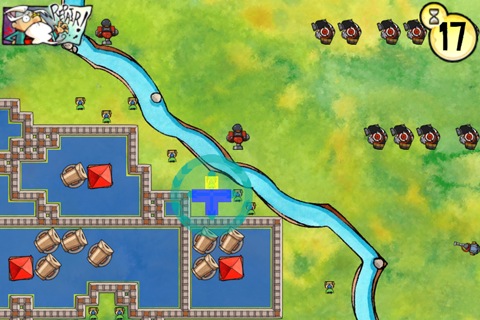
What really forces the action along in Zen Wars is that everything is timer-based. You'll only have a few short seconds to decide which tower to start building around initially, and then just a short time to place all your weapons. Cannon fire is also timed, so you'll need to wait for a cool down period for each one before firing again to prevent endless spamming of cannon fire.

Finally, the repair round is also timed, and this is where things can get really frantic. You aren't able to choose which shape your repair blocks are, you're just given them in random order. Shapes vary from single blocks, to long wall pieces, to Tetris-like angled segments. The perimeter wall around your tower can't have any breaks in it in order to use the cannons placed within, and it can be incredibly difficult to use the pieces you are given to patch things up properly. The timer just compounds this, and can send you into a state of panic if the clock is ticking down and you're not being given any of the proper pieces that you need.
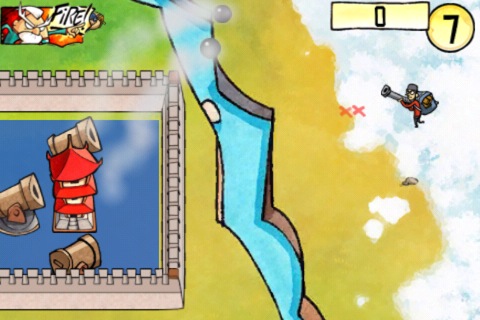
This panic will increase due to the one big downfall of the game, the finicky controls. You can pan and zoom around the battlefield using swipe and pinch gestures, and items are placed simply by dragging them where they need to go. On the smaller screen of the iPhone, things are pretty cramped, and with a timer ticking down there really isn't much room for error. Constantly having to drag to scroll the view or erroneously placing items can eat up precious time, sometimes resulting in failure.

This problem is greatly reduced playing on the larger screen of the iPad, and soon Zen Wars will be updated with universal iPad support as well as iPad exclusive modes and features. Until then, the game plays in full resolution in 2x mode on the iPad, and if you own one then I'd suggest playing on that device. You get used to the quirkiness of controlling things on the iPhone and iPod touch screen, but Zen Wars seems like a title that's tailor made for the iPad, and I'm really looking forward to the native iPad support.

While there is a ton of content and challenge on offer with the single player side of things, Zen Wars really shines in the multiplayer mode. Up to 3 players can connect locally or online through Game Center. Each player has a set of 3 towers, and the wall building and weapon placement plays out just like in the campaign, with the goal being to demolish the other players' bases. Every player gets 3 lives, and the last player standing wins.Things can get pretty crazy with 3 players in the mix all trying to blow the snot out of each other, and voice chat is included for proper smack talking. Matches tend to run pretty long, sometimes upwards of 20 minutes, which is an eternity for a mobile title. But, if you have the time set aside to play, there aren't many better multiplayer experiences on iOS than Zen Wars.

If you were a Rampart fan back in the day and have wanted a portable version on the go, nothing else in the App Store even approaches Zen Wars. Even if you aren't familiar with Rampart, the mechanics in Zen Wars are easy enough for anybody to grasp, and the strategy needed to be successful runs deep. Controls can be an issue, not because they're poorly implemented but mostly due to the small screen real estate and the looming threat of timers. It's far from a deal breaker though, and for one of the better and unique strategy offerings in the App Store, Zen Wars is a solid choice.

<!-- PHP 5.x -->


Powered By WizardRSS.com | Full Text RSS Feed | Amazon Plugin | Settlement Statement | WordPress Tutorials

Tero [99�]�� the new by-the-numbers platformer from Studio Yomi featuring the titular pilot who, oddly enough, runs and jumps instead of piloting anything � is ostensibly about saving lives.�But don't be fooled by the 24 gorgeously detailed naturescapes or the Fern Gully-inspired cautionary tale about the dangers of using science to exploit the environment. Tero is about death, about dying over and over and over again.

The thing about Tero's difficulty (besides the fact that it ramps up in, oh, the fourth level) is that it's borne out of a perfect storm of bad implementation and great design. On the one hand: Tero's accelerometer-based controls are finicky at best (tilt to run, swipe up to jump and down to attack, etc.), and its hit detection is equally spotty.

On the other hand, Tero would be a difficult game even with tighter controls, and its this idealized version that's so interesting. Despite it's slick presentation and lack of pixel art, Tero's aesthetic and design hark from an older era � blind jumps lead to nothingness, and enemies appear out of nowhere to attack Tero mid-jump. Success in Tero depends on players' ability (or willingness) to repeat themselves, to memorize patterns, to rely on muscle memory instead of intuition.

This difficulty is mitigated by short levels, generous checkpointing, and by Studio Yomi's decision to reward almost every player action with extra "lives" for Tero: collecting flowers and killing enemies yield "hearts," and Tero can be hit once for each heart in his stockpile. But despite these concessions, Tero remains a punishing game.

The result � if you have the patience � is that every death is a small lesson, another opportunity to nail the timing on this or that jump, to learn more about an enemy's pattern, to find a secret ledge, or to rack up enough hearts to bulldoze your way through. This learning process is, I think, essential to Tero, because it's after each lesson has crystalized that the game really begins to shine.

At its best, Tero is a delightfully kinetic experience � there's something triumphant about letting Tero run at full-tilt, confident in one's ability to time his jumps, kill his enemies, and collect his hearts with precision that can only be learned through repetition. Letting Tero run, dash, and spin his way through a well-memorized and well-worn level is the sublime catharsis that makes all the dying and all the frustration worth it.

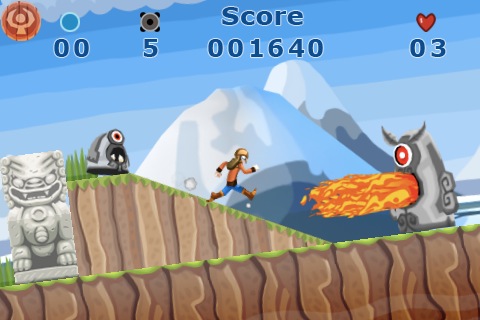
But if you lose yourself in that sublimation, you'll fail to notice just how precisely crafted each level of Tero can be. Each jump, each enemy pathfinding routine, each floating lever and invincible ghost seem purposefully placed and timed with the assumption that Tero will be running as fast as possible. Under the best possible circumstances, that flame-throwing statue isn't designed to kill Tero, but to present him with the illusion of danger as he bounces past unscathed. The real meat of the game is in its speed, timing, and grace, not in stomping baddies or saving flowers.

At first blush, Tero seems entirely unremarkable in a sea of iOS platformers, a first impression bolstered by the sketchy controls. But, under the right circumstances, Tero synthesizes the visuals of Super Mario World, the physics of Yoshi's Island, and the death-cult gameplay of games like Mega Man and Super Meat Boy into a game that strikes the perfect balance between tension and release, between frustration and delight.

<!-- PHP 5.x -->


Powered By WizardRSS.com | Full Text RSS Feed | Amazon Plugin | Settlement Statement | WordPress Tutorials

In the past, we saw that robots can do all sorts of things, such as singing and playing instruments, but we've never seen a robot that can learn and think on its own, until now.
This robot has been developed by folks from Hasegawa Group at the Tokyo Institute of Technology. Thanks to the technology called SOINN (Self-Organizing Incremental Neural Network), this robot can think like a human when it faces a task that it has never done before by making decisions based on its past experiences and knowledge.
Even if this robot doesn't know what to do in a specific situation it can easily search for instructions on the internet or it can even "ask" other robots around the world.

This robot is great, although it's first of its kind, we're hoping that we'll get more information about it in the future.

[via Ubergizmo]

Related Posts with Thumbnails


Powered By WizardRSS.com | Full Text RSS Feed | Amazon Plugin | Settlement Statement | WordPress Tutorials

As you know, robots have advanced a lot during the years, and now they can do all sorts things, and speaking of things that robots can do, did you know that robots could dance?

Although robots cannot dance as well as humans, we simply have to admire a student from Purdue University that has created a new robot called DARwIn-OP. As for the dancing part, this robot can play the game of Dance Dance Revolution, but not on its own. Creator of this project has designed a special pad for DARwIn-OP that allows it to move, but so far, this robot is being remotely controlled. This robot cannot keep its balance on its own, so it has to use a special bar that is placed in front of it, and due to lack of visual perception, this robot has to be remotely controlled at all times.

DARwIn-OP is great, but it's far from perfect, and we're hoping that we'll see an improved model that will be able to dance on its own someday in the future.

[via Ubergizmo]

Related Posts with Thumbnails


Powered By WizardRSS.com | Full Text RSS Feed | Amazon Plugin | Settlement Statement | WordPress Tutorials