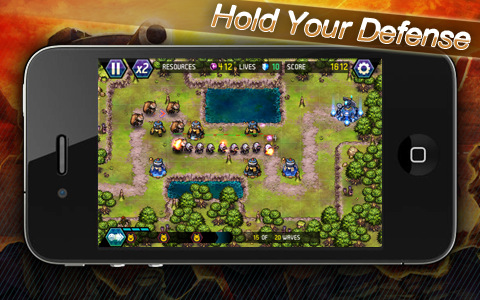
There is no way to beat around the bush, so let's just get this out of the way from the start: Com2uS trademarking "tower defense," for�Tower Defense: Lost Earth [$2.99 / HD] is a little bonkers, like if�Call of Duty was granted a trademark and changed its name to�First Person Shooter. Not only does it peeve off a bunch of developers caught in the legal crossfire, it also gives players incredibly lofty expectations for the final product when it's branded as the "officially trademarked" game of tower defense.
Thankfully, it delivers, albeit through a kitchen sink approach more than an innovative one. This is in fact a tower defense game and you'll get every single tower defense trope you've ever run into. The core campaign takes the preset route approach, where you'll set up your units on a grid and the enemies will take a predestined path. There are, however, seven different challenge stages that offer more variety, including several that utilize freeform defense where you create the enemy paths by obstructing the enemy's movements, like in�Fieldrunners [$2.99 / HD].

You'll have nine different units to choose from, each of which act as you'd expect in a tower defense game and counter the ten different enemy types in different ways. Enemy diversity is limited to slow, fast, and slow then exploding-into-fast-creatures. Killing enemies and shooting at certain environmental structures yield crystals that can be turned into more units. Some of the stages have actual resource-gathering units associated with them, but don't expect it to be a major part of the experience. The limited units and enemy types means each stage has a relatively restricted number of ways to complete it, which is altered slightly based on the difficulty setting you choose.
There are three difficulty settings, each changing the number of enemies, your starting resources or the score awarded. There are also four different game modes, the standard defense mode, a survival mode, a resource gathering mode and an attack mode. The first three are pretty self-explanatory, but the attack mode changes the dynamic of the game in an unusual way. You'll have to defend by setting up towers as you usually would, but you'll also have to expand through the level to get your units close enough to a boss to attack it. At times it's more annoying than it is innovative, as the core game doesn't change and it ends up just adding a layer of grinding.
 But for the most part, the game is well balanced and well paced and you probably won't find yourself getting stuck too often. There were a few levels that stumped me where I was wishing there was a help or skip function, but for the most part, if you follow the "rock, paper, scissors" approach to defending against enemies, you'll get through the campaign on the easiest setting with little trouble. As far as strategy is concerned, there are two different ways you can approach a match, either by upgrading your units (you get two upgrades to each unit) or by scattering a ton of units across the map. Upgrading seems to work better in the long term, but your mileage may vary. If you find yourself in a pinch, each level offers you one additional attack with a one-time use. These include gas that slowly drains enemy life, a ship that drops bombs and others.
Perhaps because Com2uS is already in deep water with a lot of players because of the trademarking, it should come as no surprise the game is well executed. Visually, it has the same look as a lot their RPGs, with well-animated sprites, diversity in the environments and a reasonably long campaign. The menus and interface are well laid out and work well on both the iPhone and iPad. Although the game is refined, it's still generic sci-fi nonsense, clearly inspired by the menus of nearly every single PC science fiction game in existence. The sound doesn't live up to the visuals, with comparatively underwhelming enemy and weapon sound effects.
The campaign does feature a story mode, but it reads like pretty much every RTS storyline ever written. You need to expand to save the human race and to do so, you've decided to exploit the resources of an alien planet. The inhabitants aren't too keen on this idea and start attacking your settlements by running at your guns in waves. It's commendable�Tower Defense: Lost Earth tries to add a narrative layer, but the fact you're the invading party, not the defending one makes the story come across as more ridiculous than it already is.
There is leaderboard integration with Game Center as well, but the options are relatively limited. With as much development effort that was clearly dumped into the game, you'd expect to see a bit more stat tracking, trophies or more complex leaderboards. That's only going to matter to some people, but for statistics nerds, the streamlined leaderboards might be a bit of a disappointment.
There is no way around the fact that naming your game after a genre is really not that wise of a decision, but�Tower Defense: Lost Earth does a good job of providing exactly what you'd expect from it. Still, it's hard to shake the feeling the game is missing something � it's a well-executed genre game, but it lacks character. It's not going to fundamentally change what we expect from the genre, it's not going to shift mountains or alter the collective consciousness, but it will give tower defense nuts a deep and nicely packaged experience� And really, what more can you ask for?
Note: Tower Defense: Lost Earth is presently being advertised on this site, but it has no influence on our choice of coverage or the outcome of our reviews. See advertising and editorial policies for additional details.
<!-- PHP 5.x -->





 LG officially announced their first ever phone with 3D technology at MWC which is known as